
Registered Environmental Health Specialist/Registered Sanitarian Credential

Professionals who hold the Registered Environmental Health Specialist / Registered Sanitarian (REHS/RS) credential demonstrate competency across a broad range of environmental health disciplines, including vector control, water quality, hazardous materials, air quality, the built environment, and emergency environmental response.
REHS/RS credential holders working in the private sector play a critical role in protecting public health within organizations and industry. They interpret environmental health regulations, ensure facility and operational compliance, develop and manage environmental health and safety programs, conduct internal audits and risk assessments, implement corrective actions, and train staff on best practices. Their expertise helps organizations proactively prevent environmental health risks, maintain regulatory compliance, and safeguard both communities and brand integrity.
REHS/RS credential holders working in regulatory or government roles are essential to ensuring communities comply with local, state, and federal environmental health regulations. Through inspection, enforcement, education, and policy implementation, they protect public health at the population level.
Ready to Apply?
Submit your application by going to MyNEHA, login or create your account, and select "Credentials & Exams"
Become an REHS/RS Credential Holder
Eligibility Requirements
Candidate must meet all of the criteria for Track A, Track B, or Track C to be eligible to apply for the REHS/RS exam.
Track A – Environmental Health Degree
Candidates must meet the following criteria to apply for this track:
- Hold a Bachelor's degree, Master's degree or PhD from a college or university accredited in the United States. Review the requirement for international degrees and diplomas below (Transcript Review)
- Hold a degree in Environmental Health
- Have attended a school and degree program that has been accredited by the Environmental Health Accreditation Council:
EHAC-Accredited Environmental Health Bachelor's Degree Programs
EHAC-Accredited Environmental Health Master's Degree or PhD
Proof of work experience is not required.
Track B – Bachelor's Degree
Candidates must meet the following criteria to apply for this track:
- Hold a bachelor's degree, master's degree or PhD from a college or university accredited in the United States in any subject. Review the requirement for international degrees and diplomas below (Transcript Review).
- Have earned 30 semester hours (or 45 quarter hours) of college credit in basic science coursework. Basic sciences include life sciences, natural sciences, physical sciences, or health sciences. We do not count social science courses such as Sociology or Psychology toward the basic science requirement.
- Have earned credit for a college level math or statistics class.
- Have two or more years of full-time, paid experience working in environmental health. Eligible areas of environmental health include: general environmental health (including inspections, environmental microbiology, and contamination control), food protection, wastewater, solid and hazardous waste, potable water, inspections of facilities, vectors and pests, institutions and licensed establishments, swimming pool inspections, radiation, occupational safety and health, healthy housing, indoor air quality, disaster and emergency planning, and environmental health issues related to climate change.
Track C – In Training
This track allows candidates with less than two years of qualifying work experience to take the exam.
Candidates must meet the following criteria to apply for this track:
- Hold a bachelor's degree, master's degree or PhD from a college or university accredited in the United States in any subject. Review the requirement for international degrees and diplomas below (Transcript Review).
- Have earned 30 semester hours (or 45 quarter hours) of college credit in basic science coursework. Basic sciences include life sciences, natural sciences, physical sciences, or health sciences. We do not count social science courses such as Sociology or Psychology toward the basic science requirement.
- Have earned credit for a college level math or statistics class.
Proof of work experience is not required.
Certificates for those who pass the exam in this track:
- Will receive a certificate that says "REHS/RS – In Training"
- Have three years to obtain two years of work experience
- Must submit work experience to us to qualify for the full REHS/RS
"In Training" status expires if work experience is not submitted within three years.
Individuals cannot qualify for the REHS/RS Credential if they:
- Do not hold a bachelor's degree, master's degree or PhD from a college or university accredited in the United States in any subject (and no international degree).
- Have not earned 30 semester hours (or 45 quarter hours) of college credit in basic science coursework. Basic sciences include life sciences, natural sciences, physical sciences, or health sciences. We do not count social science courses such as Sociology or Psychology toward the basic science requirement.
- Have not earned credit for a college level math or statistics class.
The REHS/RS credential criteria are set by our Board of Directors. We cannot accept work experience in lieu of college coursework.
Applications must be completed online for review at least two weeks prior to the desired exam date.
A complete application must include:
- All official college transcripts. Transcripts must be provided to us in one of the following ways to be considered an official transcript:
- Emailed from the school or transcript service to credentialing@neha.org (preferred method)
- In the sealed envelope from the college Registrar's Office/Transcript Office
- Work Experience Verification Form, unless applying Track A or C
- Appropriate fees
- Third party review if education is international
Expiration
Applications are valid for one year from the date we receive them. If the test has not been taken within one year of applying, new application and fees must be submitted. Pearson VUE testing authorizations are valid for one year.
All fees must be paid in full before the application is processed.
| Member Rate | Non-Member Rate | |
| Application Fee | $105.00 | $140.00 |
| Examination Fee | $225.00 | $335.00 |
| Pearson VUE Fee | $195.00 | $195.00 |
To apply, complete the online application:
- Go to MyNEHA.
- Login or create a NEHA account.
- Select " Credentials & Exams" in the top right.
- Select "Apply for Certification."
- Choose REHS/RS from the menu.
- Complete the application and submit. Progress can be saved and returned to as needed.

International Education
Individuals who received their college or university higher education from outside the United States or its territories must provide an evaluation report from a third-party international education evaluation service to determine:
- equivalency to a bachelor's degree in the U.S. if applying for a food safety credential,
- that the candidate has completed 30 semester hours (or 45 quarter hours) of college level core science education—a combination of biological sciences, chemistry, physical sciences, food technology, nutrition, medical science, engineering, epidemiology, veterinary medical science, or related science field if applying for the REHS/RS.
International Educational Documents
Unfortunately, we cannot evaluate international educational documents even if they have been translated into English. They must be evaluated by an international education specialist. Canadian education is considered foreign education and hence must be evaluated by a third-party evaluation service.
We strongly recommend a service that is a member of the National Association of Credential Evaluation Services.
United States Education
Candidates with education from within the United States who are not sure if they qualify academically or require a letter from us stating they meet the academic qualifications can request a review of their transcripts for eligibility.
- Complete the Transcript Review Request Form
- Submit the $75 non-refundable fee with the request form
Allow two weeks for a transcript to be reviewed. Candidates will be notified by e-mail.
- The REHS/RS exam consists of two parts with a total of 225 multiple choice questions.
- Part 1 asks 113 questions
- Part 2 asks 112 questions
- Candidates have three hours and 40 minutes to complete the entire exam or one hour and 50 minutes for each part with a 10-minute break in between
- Of the 225 questions, 200 will be scored
- 25 questions will be unscored, pilot questions. Those items will not be called out within the exam.
- Review the exam outline of the content areas included in the exam and the percentage allotted to each area.
REHS/RS Exam Content
REHS/RS Exam Scores
- The NEHA REHS/RS exam reports scores ranging from 0 to 900 with a scaled passing score of 650.
- Scores are based on the number of questions answered correctly.
- Exam results are emailed to the candidate within two weeks after the exam.
- Those who pass the exam will receive a certificate and continuing education information.
- Those who fail the exam will receive a score letter and a retake application. Candidates must wait at least 90 days from the initial test date before retaking the exam.
- To retake the exam, submit the Retake Application and pay the Exam Fee and Computer Test Fee.
- The application and transcripts do not need to be submitted again.
- The exam can be taken as many times as needed but candidates must wait at least 90 days before retaking the exam.
About Exam Scores
- The raw passing score is mathematically transformed so that the passing scaled score equals 650. The scaling process is similar to the adjustment for Celsius and Fahrenheit temperature scales. While the values may differ, the temperatures are the same (e.g., water boils at the same temperature regardless of the scale used).
- A scaled score is not a percentage score but a transformation of a raw score. Scaling is done to report comparable results when forms and raw passing scores vary over time.
- More details about exam scores here
These study materials are recommended to prepare you for the Registered Environmental Health Specialist/Registered Sanitarian (REHS/RS) credential exam.
REHS/RS Online Study Course
The REHS/RS Online Study Course is a self-paced learning experience designed to support entry- to mid-level environmental health professionals as they move from foundational knowledge toward practical application and credential readiness.
Grounded in the validated REHS/RS job task analysis and aligned with the REHS/RS body of knowledge, this course helps learners organize, connect, and apply core environmental health concepts in ways that reflect real-world practice. It is ideal for professionals who have gained foundational knowledge through education or field experience and are ready to deepen their understanding as responsibilities expand.
Course content spans key environmental health domains, including food safety, onsite wastewater, drinking water, recreational water, housing and institutions, inspections, investigations, compliance review, and risk assessment. Material is delivered in a modular format, allowing learners to progress sequentially or revisit specific topics as needed. The self-paced structure supports flexible learning without travel, fixed schedules, or time away from essential duties.
This course is one component of NEHA's intentionally designed REHS/RS learning portfolio. The REHS/RS Study Guide establishes foundational scientific and regulatory knowledge. The REHS/RS Online Study Course builds on that foundation by reframing knowledge for applied professional use. Finally, the REHS/RS Practice Exam allows learners to assess readiness and build confidence prior to sitting for the REHS/RS credential examination.
Agencies may also use this course as part of onboarding, mentoring, or professional development pathways. Individuals may use it to consolidate experience, refresh knowledge, or prepare for credentialing as a professional milestone.
This course does not replace instructor-led training or the credential exam. Instead, it provides a structured, accessible bridge between learning, practice, and professional advancement.
Purchase REHS/RS Online Study Course
REHS/RS Study Guide
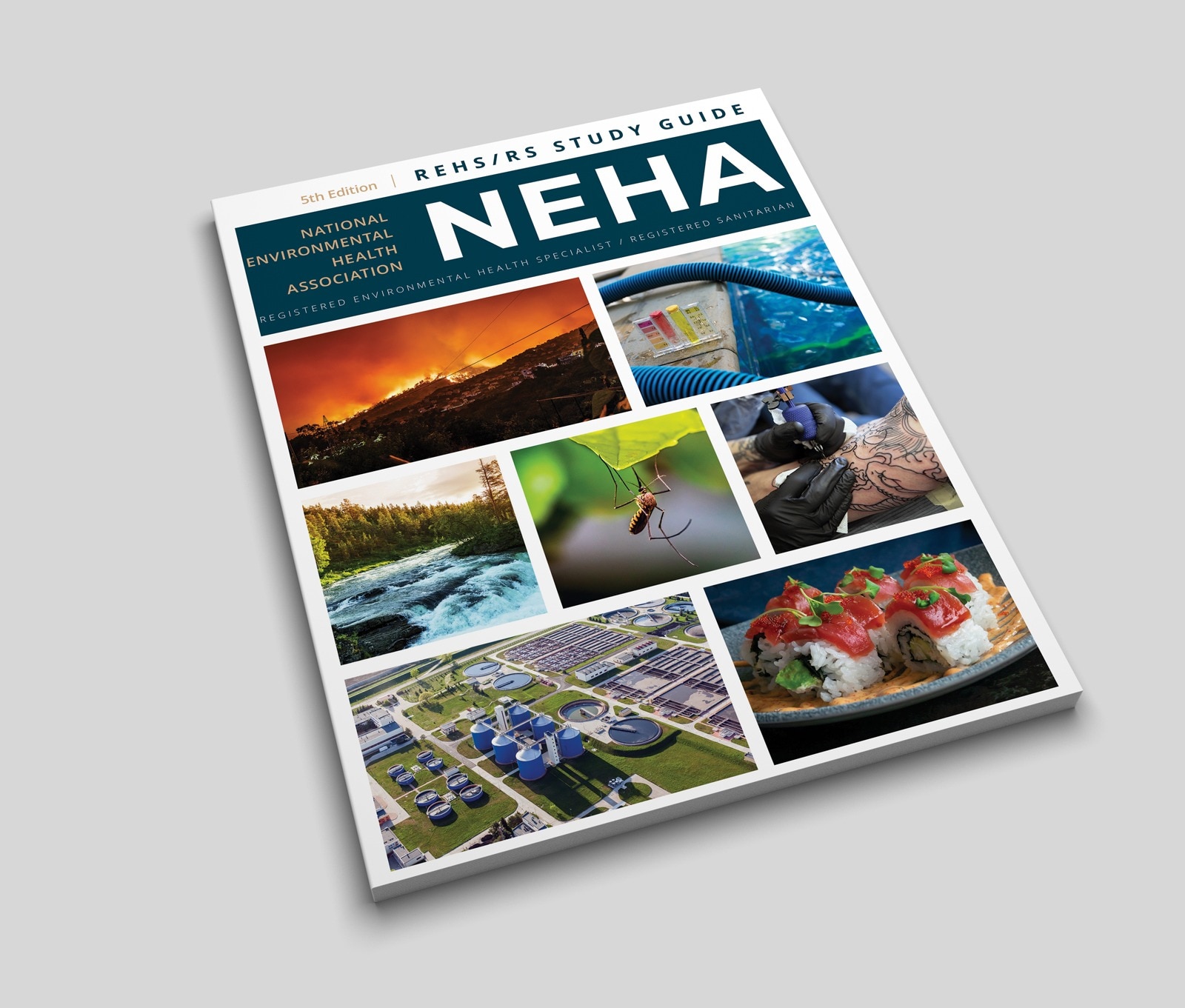
The REHS/RS Study Guide reflects the most recent changes and advancements in environmental health technologies and theories. The new edition incorporates the insights of nearly 30 subject matter experts from across academia, industry, and the regulatory community, paired with references from over 30 scholarly resources. It also includes a fresh visual layout to enhance the reading and studying experience.
It includes 15 chapters that each cover different environmental domains and is divided into standardized sections including Roles and Responsibilities, Recommended Reading, and Test Mapping. Each chapter includes sample exam questions.
Chapter Topics
- General Environmental Health
- Statutes and Regulations
- Food Protection - based on the 2017 FDA Food Code (consistent with the current credentialing exam)
- Potable Water
- Wastewater
- Solid and Hazardous Waste
- Hazardous Materials
- Zoonoses, Vectors, Pests, and Poisonous Plants
- Radiation Protection
- Occupational Safety and Health
- Air Quality and Environmental Noise
- Housing Sanitation and Safety
- Institutions and Licensed Establishments
- Swimming Pools and Recreational Facilities
- Emergency Preparedness
REHS/RS Study Guide e-book
The REHS/RS Study Guide e-book e-book is available for Android or Apple users. Like the paperback version, the e-book reflects the most recent changes and advancements in environmental health technologies and theories. Incorporating the insights of nearly 30 subject matter experts from across academia, industry, and the regulatory community, paired with references from over 30 scholarly resources, this essential reference is intended to help those seeking to obtain the NEHA Registered Environmental Health Specialist/ Registered Sanitarian Credential.
Purchase the REHS/RS Study Guide e-book (Android)
Purchase the REHS/RS Study Guide e-book (Apple)
REHS/RS Online Practice Exam

The REHS/RS Online Practice Exam for the REHS/RS credential has been redesigned and updated. The redesigned practice exam was created by subject matter experts and constructed to better simulate the experience of taking the credentialing exam.
Highlights
- Updated question bank with more than 1,000 questions
- Access to question bank by topic area (e.g., food protection, potable water)
- Unlimited practice exams with new questions each time
- Same number of questions as the credential exam
- Same ratio of questions per topic as the credential exam
- Improved, more consistent user experience
- Access on your phone or tablet
Your subscription provides you with access to the practice exam for 12 months, giving you plenty of time to study.
The online practice exam is an additional resource, not a replacement for, the REHS/RS Study Guide and/or the REHS/RS Online Study Course.
Additional Materials
The REHS/RS exam covers a wide range of topics, so there are plenty of resources and supplementary materials to help you prepare. Some resources focus on a broader range of content than others. From our review of released practice exam questions, we found that some resources were more frequently used than others.
The following lists include references to assist you in preparing for the REHS/RS credential exam. If you can only purchase or borrow a few textbooks to study from, choose these five:
- Nemerow, N.L., Agardy, F.J., Sullivan, P., & Salvato, J.A. (Eds). (2009). Environmental Engineering: Prevention and Response to Water-, Food-, Soil-, and Air-borne Disease and Illness (6th ed.). John Wiley & Sons, Inc.
- Nemerow, N.L., Agardy, F.J., Sullivan, P., & Salvato, J.A. (Eds). (2009). Environmental Engineering: Water, Wastewater, Soil and Groundwater Treatment and Remediation (6th ed.). John Wiley & Sons, Inc.
- Nemerow, N.L., Agardy, F.J., Sullivan, P., & Salvato, J.A. (Eds). (2009). Environmental Engineering: Environmental Health and Safety for Municipal Infrastructure, Land Use and Planning, and Industry (6th ed). John Wiley & Sons, Inc.
- Koren, H., & Bisesi, M.S. (2003). Handbook of Environmental Health, Volume 1: Biological, Chemical, and Physical Agents of Environmentally Related Disease (4th ed). CRC Press.
- Koren, H., & Bisesi, M.S. (2003). Handbook of Environmental Health, Volume 2: Pollutant Interactions in Air, Water, and Soil (4th ed.). CRC Press. [HF1]
If you have the ability to purchase or borrow additional resources to study from, add these four:
- Food and Drug Administration. Model Food Codes.
- National Environmental Health Association. (2021). REHS/RS Study Guide (5th ed.).
- Marriott, N.G., Schilling, M.W., & Gravani, R.B. (2018). Principles of Food Sanitation (6th ed.). Springer.
- Pool & Hot Tub Alliance. (2016). Pool & Spa Operator Handbook.
Finally, if you have the ability to purchase or borrow more resources to study from, choose from the following:
- California Association of Environmental Health Administrators. (2012). Disaster Field Manual for Environmental Health Specialists.
- Carter, M. (2007). Soil Sampling and Methods of Analysis. CRC Press.
- Das, D.B., & Chandrappa, R. (2012). Solid Waste Management: Principles and Practice. Springer Berlin Heidelberg.
- Ewing, K.A., McCall, D.R., III, Case, D.R., Miller, M.L., Steinway, D.M., Nardi, K.J., Bell, C., Landfair, S.W., Olney, A.P., Richichi, T., Brownell, F.W., King, J.O., Scagnelli, J.M., Spensley, J.W., von Oppenfeld, R.R., & Davis, A.N. (2019). Environmental Law Handbook (24th ed.). Bernan Press.
- Ginter, P.M., Swayne, L.E., & Duncan, J.W. (2018). The Strategic Management of Health Care Organizations. John Wiley & Sons, Inc.
- Glasson, J., & Therivel, R. (2019). Introduction To Environmental Impact Assessment. Taylor & Francis.
- Hellberg, R.S., Everstine, K., & Sklare, S.A. (2020). Food Fraud: A Global Threat with Public Health and Economic Consequences (1st ed.). Academic Press.
- Heymann, D.L. (Ed). (2014). Control of Communicable Diseases Manual (20th ed). APHA Press.
- Kapur, B.J. & Smith, J.P. (2011). Emergency Public Health: Preparedness and Response. Jones & Bartlett Learning.
- Klaassen, C.D. (2013). Casarett & Doull's Toxicology: The Basic Science of Poisons (8th ed.). McGraw-Hill Professional.
- Knechtges, P.L., Kearney, G.D., & Resnick, B.A. (2018). Environmental Public Health: The Practitioner's Guide. APHA Press.
- Lundgren, R.E., & McMakin, A.H. (2018). Risk Communication: A Handbook for Communicating Environmental, Safety, and Health Risks. John Wiley & Sons, Inc.
- Meyer, E. (2013). Chemistry of Hazardous Material (6th ed.). Pearson.
- Moeller, D.W. (2011). Environmental Health (4th ed.). Harvard University Press.
- Morgan, M.T. (2003). Environmental Health (3rd ed.). Wadsworth, Inc.
- Nadakavukaren, A., & Caravanos, J. (2020). Our Global Environment: A Health Perspective (8th ed.). Waveland Press, Inc.
- Oleckno, W.A. (2002). Essential Epidemiology: Principles and Applications. Waveland Press, Inc.
- Oleckno, W.A. (2008). Epidemiology: Concepts and Methods. Waveland Press, Inc.
- Singh, R.L., & Mondal, S. (2019). Food Safety and Human Health. Academic Press.
- Wong, J.W, Surampalli, R.Y., Zhang, T.C., Rajeshwar, D.T., & Selvam, A. (Eds.). (2016). Sustainable Solid Waste Management. American Society of Civil Engineers.
- Yassi, A., Kjellstrom, T., de Kok, T., & Guidotti, T.L. (2001). Basic Environmental Health. Oxford University Press.
- Yates, W.D. (2017). Safety Professional's Reference and Study Guide. CRC Press.

Candidates can schedule a credential exam:
- At a Pearson VUE's testing location anywhere in the United States and internationally. Individuals who take the exam at Pearson VUE will receive their unofficial scores immediately after the exam.
Testing at Pearson VUE
- When the exam application is approved, candidates will receive an authorization email from us.
- One to three days later the candidate will get an email from Pearson VUE c/o PTI with the PTI ID number and instructions for scheduling the exam at Pearson VUE. The PTI ID number is valid for one year.
- On test day, candidates must bring one form of identification (i.e., driver's license or passport) to the testing site.
To reschedule the testing date/time, contact Pearson VUE at least 24 hours prior to the scheduled test time. At least 24 hours notice is required to cancel the exam without losing fees. Candidates must contact us to pay fees and be authorized to reschedule.

Special Accommodations for Candidates with Disabilities or Impairments
It is our goal to ensure that all individuals have the opportunity to take a credentialing examination irrespective of a disability or impairment.
- All computer test centers are accessible and compliant with the American with Disabilities Act (ADA).
- To make a request for special accommodations, complete the Accommodation Request Form and Documentation of Disability Related Needs Form
- E-mail the forms to our Credentialing Department as soon as you complete your online credential application. In the email, attach the two completed forms which should include:
- specific diagnosis, medical records or other written proof of the diagnosis by an appropriate licensed professional
- accommodation being requested
All matters related to testing accommodations will only be communicated by our staff with the candidate, professionals knowledgeable about the candidate's disability or impairment, the candidate's authorized representative (if applicable), Professional Testing Inc. (PTI), and the test administrator or proctor.
The Credentialing Handbook answers many questions and is a useful tool in navigating this process. You can access it here.
State Exams and Reciprocity

The following information is for state administrators and/or candidates ordering an exam to become a state-appointed Registered Sanitarian (RS), Registered Environmental Health Specialist (REHS), Licensed Environmental Health Professional (LEHP), etc.
Exam Instrument
The states of Arizona, Connecticut, Florida, Georgia, Illinois, Maryland, Minnesota, Montana, Nevada, North Carolina, Ohio, Oregon, Washington, West Virginia, and Wisconsin have an environmental health program that uses the our REHS/RS exam instrument. Contact the state program office for more information.
Individuals working in any state not listed in the state program office can apply for the REHS/RS Credential if they meet the criteria.
Ordering & Payment
In Florida, Georgia, Illinois, North Carolina, Ohio, and Washington, the state orders and pays for credential exams.
- The state program representative will send us the applicant's name and payment
- After we process the application, the candidate will receive an email from pearson@proftesting.com with instructions to schedule the exam
Individuals working in other states are responsible for ordering and paying for their exam by:
- Gathering the electronic version of the state approval (letter, email, etc.)
- Creating an account or sign in to the MyNEHA portal
- Selecting "Credentials & Exams," then "Apply for Credential/State Exam"
After the application is processed by us, the candidate will receive an email from pearson@proftesting.com with instructions to schedule the exam.
REHS/RS Exam Costs
The cost to use the REHS/RS exam for state licensure is $280.
The fee is non-refundable or transferable and includes:
| Member Rate | |
| Exam Content | $50.00 |
| Exam Delivery | $150.00 |
| Staff time | $80.00 |
| Total | $280.00 |
State Authority
A state credentialing exam cannot be purchased or scheduled without approval from the state program office. Our role is only to facilitate scheduling and payment of the exam. The state determines:
- Eligibility
- Scores
- Certification status
- Continuing education requirements
Contact us for questions by emailing our Credentialing Department or call us at 303-802-2146.
If you hold a state REHS/RS or RS credential, you may be eligible to receive the NEHA REHS/RS credential without re-examination (reciprocity).
Eligibility
To be eligible for reciprocity you must:
- Have a valid (unexpired), current state registration; and
- Have at a minimum a bachelor's degree with 30 semester/45 quarter hours in basic sciences; and
- Have proof of passing the REHS/RS exam that was used by NEHA at the time you tested:
- NEHA REHS/RS exam taken on or after July 13, 2014 with a score of 650 or higher.
- NEHA REHS/RS exam taken between January 1, 1998 and July 12, 2014 with a score of 68% or higher.
- Professional Examination Service (PES) exam taken prior to December 31, 1997 with a score of 70% or higher.
If you meet all of these qualifications, you qualify for reciprocity. If you do not, reciprocity is not available.
State Specific Reciprocity
Arizona
- You may qualify for regular reciprocity if you took the PES exam before December 31, 1997 or the NEHA REHS/RS exam after January 1, 2013. The one year Open Window Reciprocity opportunity expired on February 28, 2014.
California
- California state REHS/RS exams taken before August 1992 may be eligible for reciprocity. California state exams taken after August 1992 are not eligible due to the different exam used in California.
Connecticut
- You may qualify for regular reciprocity if you took the PES exam before December 31, 1997 or the NEHA REHS/RS exam after January 1, 2013. The one-year Open Window Reciprocity opportunity expired on February 28, 2014.
Ohio
- You may qualify for regular reciprocity if you took the PES exam before December 31, 1997 or the NEHA REHS/RS exam after January 1, 2013. The 1 year Open Window Reciprocity opportunity expired on February 28, 2014.
Texas
- Only the full-length NEHA REHS/RS exam (4 hours, 250 questions) is eligible. The shorter Texas RS exam (130 questions) is NOT eligible for reciprocity.
Follow these steps to complete the application:
Step 1: Go to [www.neha.org](https://www.neha.org) and log in or create a MyNEHA account
Step 2: Application Fees:
- NEHA members* = $170 (*Membership is optional and MUST be purchased before applying for reciprocity if you wish to obtain the member price).
- Non-Members = $220 for non-members
Step 3: Go to Credentials & Exams >> Applications >> Registered Environmental Health Specialist/Registered Sanitarian (REHS/RS) >> scroll to the bottom of the page and select REHS/RS Reciprocity.
Step 4: The application will walk you through the steps.
Steps 5: Complete all the steps, then process and pay.
The application will forwarded to the Credentialing Department after your payment has been processed.
Documentation for Reciprocity
State Registration
- If you're not sure if you hold a state registration, contact your state registration program. If you do not have a current registration card or certificate showing an expiration date, request one from your state registration program.
Bachelor's Degree
- If you're not sure if your bachelor's degree includes at least 30 semester hours or 45 quarter hours of basic science, review your college transcripts. We consider basic science courses to include Life Sciences, Natural Sciences, Physical Sciences or Health Sciences. We can request evaluate your college transcripts for $75.
Exam
- If you're not sure which type of exam you took, the date you tested, or your score, check your personal documents from your state registration program or contact them for your specific information. We can provide state exam scores, but we must have the approximate date you took it (records are filed in date order, not by name).
Maintain Your Credential
To maintain the REHS/RS credential, individuals must:
- Earn and submit a minimum of 24 hours of continuing education every two years
- Pay renewal fee every two years ($180 members; $345 non-members)
- Agree to and sign our Code of Ethics

NEHA credentials are valid for two years after which they must be renewed. Renewal notices are sent to the email address included in your MyNEHA account.
Renewal fees for REHS/RS, CP-FS and CCFS credentials is $180 for members or $345 non-members every two years.
To renew a NEHA credential the credential holder must:
- Submit the required number of continuing education contact hours
- Pay the renewal fee
Renewal Instructions
- Please make sure you have the sufficient number of CEs. To check your verified CEs, log into your account, click Credentials & Exams > View My Credit History > Download Transcript. This is the only place to check your approved continuing education credits.
- Select "Credentials & Exams" from the menu and then choose "View/Renew My Credentials". Select the circle to the left of your credential and click "Renew" that appears above. The renewal process will walk you through the steps and you will be asked for payment at the end.
A receipt will be emailed after the transaction is complete.
Other Payment Options
Payment may also be made by calling 303.802.2135 or mailing a check to:
National Environmental Health Association
Dept. #42471
PO Box 650823
Dallas, TX 75265-0823
Late Fee
There is a late fee applied when renewal fees and CEs are not received by the credential expiration date.
Print Your Credential Any Time
You can print or save a PDF copy of your credential at any time.
- Login to MyNEHA
- Select "Credentials & Exams"
- Select "View/Renew My Credentials"
- Select the round button next to your credential, a light gray bar will appear with the word "Print"
Select "Print" or save it as a PDF

Credential Requirements
During the two-year credential period, the following continuing education contact hours must be earned to maintain the credential. We measure continuing education in contact hours. One "contact hour" is one clock hour of learning time. One CEU is equal to 10 contact hours.
- CCFS: 24 Contact Hours
- CP-FS: 24 Contact Hours
- REHS/RS: 24 Contact Hours
Eligible Continuing Education
The following educational opportunities are eligible for continuing education credits as long as they relate to the environmental health field, including food, water, wastewater, air, vector and pest control, hazardous materials and/or waste management, radiation, recreation, housing, and institutional health and safety, occupational health and safety, program planning and legal aspects, or general environmental health and scientific concepts:
- Conferences, seminars, classes, lectures, online trainings, etc.
- Up to 10 hours of course instruction that you teach per credentialing cycle.
- Articles written for journals or other academic publications, up to 10 hours per credentialing cycle. A copy of the article must be submitted to us.
- Undergraduate and graduate-level university courses. We grant 16 contact hours for each semester credit hour and 13 contact hours for each quarter credit hour.
Non-eligible Continuing Education
- Submitting the same course more than once for different credentials.
- Books or book reviews.
- Work hours.
- Credential study/review courses, since they take place before the credential is in effect.
- Contact hours earned in the previous credentialing cycle. To ensure "continuing education" is ongoing, we do not carry over continuing education contact hours from one renewal cycle to the next.
CE-Approved Courses
There are many courses available through MyNEHA that can be used for continuing education (CE) credits. While many courses require a membership, others are available to anyone. Non-members can create a MyNEHA account to access non-member courses.
For NEHA Members
- E-Learning
- No cost to NEHA members
- Presentation video, materials, online quiz, certificate of completion (after completing quiz)
- Each hour of course material is equivalent to one NEHA-approved CE contact hour
- There is no limit on the number of CEs obtained by this method
- Journal of Environmental Health Quiz
- No cost to NEHA members
- Complete the quiz found in each issue of the JEH
- Each completed quiz is equivalent to one NEHA-approved CE contact hour
- Food Safety Instructor Training
- Continuing education credits can be earned for the corresponding number of hours of food safety training taught by a NEHA-registered instructor who has earned their NEHA credential, up to 10 hours per credentialing period.
For NEHA Members & Non-Members
- Annual Educational Conference (AEC) & Exhibition and Virtual Conferences
- Continuing education credits are available for attending our annual AEC or any NEHA virtual educational event
- Webinars & Partner Courses
- Videos, virtual conferences, and online training in the environmental health field
Request Pre-Approval of Continuing Education for an Event
Conferences, seminars, classes, lectures, and online trainings are all acceptable forms of continuing education if they are related to the environmental health field – food, water, wastewater, air, vector and pest control, hazardous materials and/or waste management, radiation, recreation, housing and institutional health and safety, occupational health and safety, program planning and legal aspects, or general environmental health and scientific concepts.
Apply for CE program approval using MyNEHA:
- Log into your MyNEHA account
- Select Credentials & Exams, then Applications
- Select Transcript Review/CE Program Approval
- Select the Apply button below the CE Program Approval heading
- Follow the steps to complete the online application
Continuing Education Audit
Retain all supporting documentation in case of an audit. You do not need to send us documentation unless you are selected for an audit and are contacted by one of our staff with instructions.
- Login to MyNEHA
- Select Credentials & Exams from the menu, then Self-Report CEU Credits
- Complete the form (round up to the nearest half hour) and select Create. Half hours should be entered as ".5".
Courses completed through our E-Learning are automatically added to the account. CEs are approved daily by our staff and can be confirmed by logging in to MyNEHA. Items with an "edit" or "delete" next to them have not yet been verified by us.
Instructions for Downloading Self-Reported CEs
- Login to MyNEHA
- Select Credentials & Exams near the top of the page
- Select View My CEU Credit History from the drop-down menu
- Select Download Transcript on the My CEU Credit History page and a PDF will open in a new window to download or print
Some individuals may be interested in Emeritus status of their REHS/RS credential (i.e. REHS/RS-E to indicate Emeritus status). With this designation, individuals may consult, work, teach, and/or volunteer in environmental health, and must use the designation REHS/RS-E. Resuming active use of the credential requires a written request to NEHA's Credentialing Department and additional fees. To qualify for Emeritus status, individuals must:
- Have completed a minimum of 15 years of service in the environmental health field and,
- Have a current NEHA credential that is in active status (i.e. not currently expired) and,
- Not plan to consult, work (part-time or full-time), teach, or volunteer in environmental health as a full-fledged (i.e. REHS/RS) credential holder and,
- Submit payment of $75 (member)/$100 (non-member) for the status change
Email credentialing@neha.org for the Emeritus request form.